










Light waves normally pass through each other without interacting, but in certain nonlinear materials they can exchange energy and momentum. This property allows a strong wave, called a pump, to modify the frequency or direction of a weaker signal. In this work, we demonstrate a new method to control microwave signals using an engineered superconducting structure known as a Josephson metamaterial.
Josephson metamaterials have been used for over a decade to amplify weak microwave signals in superconducting circuits. Here, we introduce a different approach based on a two-mode device in which the pump wave travels more slowly than the signal. This enables the conversion of an incoming microwave signal into a wave propagating in the opposite direction. As a result, the forward signal is strongly suppressed, allowing the device to operate as a microwave isolator that permits transmission in only one direction. By tuning the pump, the same device can also function as a controllable and reversible coupler.
The device operates over a broad microwave frequency range and provides significant isolation with useful bandwidth. With further optimization, this technology could become a valuable component for routing and processing microwave signals in superconducting quantum circuits and other advanced electronic systems.
This work, led by the QUANTIC team, was published in the journal Nature Communications.
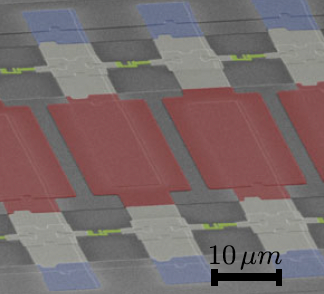
A false-color scanning electron microscope image of our Josephson metamaterial. Several of the device’s 400 unit cells are visible. Each unit cell contains three parallel-plate capacitors and two Josephson junctions.