



The team’s activities cover various aspects of dynamical quantum transport, from electronic quantum optics and cavity quantum electrodynamics to Dirac fermion electronics, topological matter and microwave quantum photonics. It studies model systems such as carbon nanotubes, graphene, quantum Hall effect edge channels in semiconductor heterostructures, or topological insulators. The devices are mostly fabricated in the laboratory using cleanroom nanofabrication techniques. They are characterized by quantum transport and noise measurements in the microwave range. The four major themes of the team are described below.
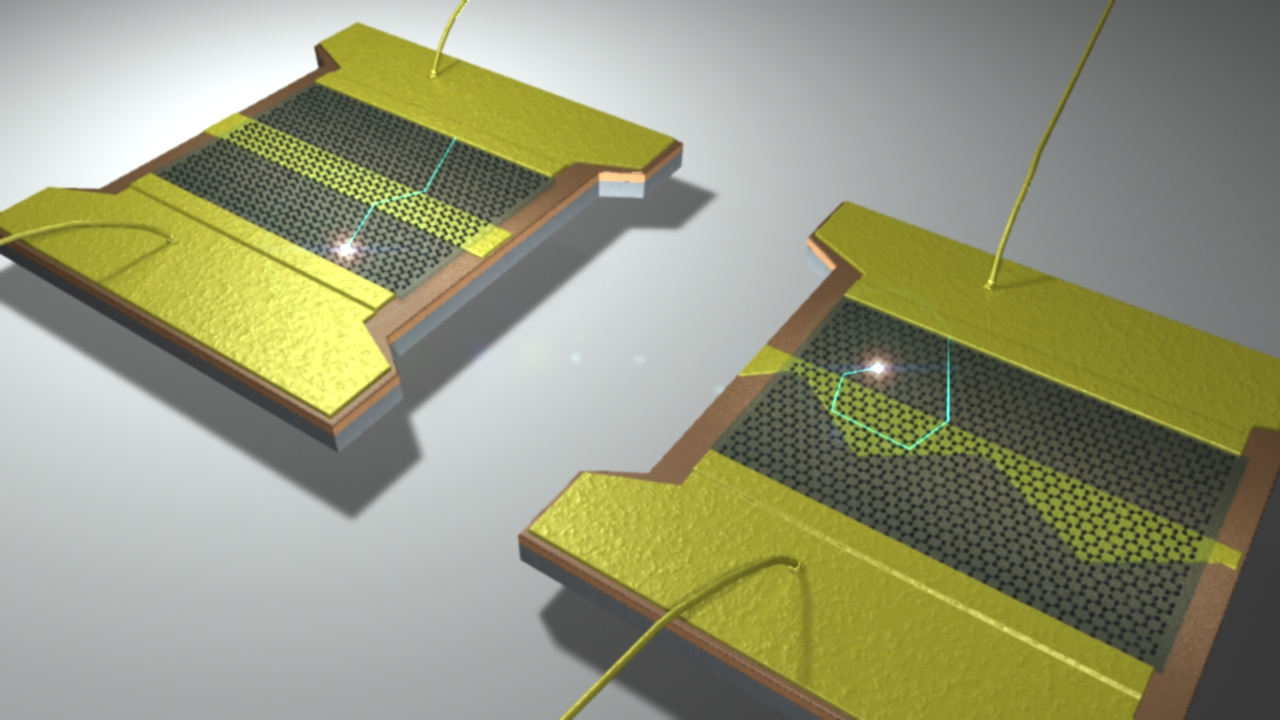
Dynamical transport in graphene
Our team studies electronic dynamics in graphene/BN heterostructures of high mobility by transport and microwave experiments. We are interested in interaction effects of Dirac fermions in optic electronics and plasmonic regimes, as well as in coupling to light and phonon-polaritons in van der Waals insulators. Beyond graphene, this approach is applied to semiconducting and topological insulator heterostructures.
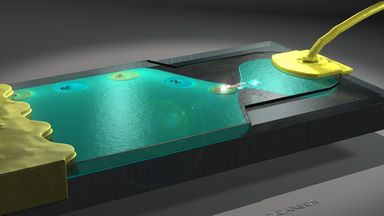
Electronic quantum optics
Our team studies two-dimensional layers of high-mobility electrons (AlGaAs/GaAs). On one hand, the dynamics of coherent conductors: how are quantum Kirchhoff laws modified at high frequency? What is the relaxation time of quantum coherent RC circuit? What is the elementary quantum inductance associated to a quantum mode? On the other hand, manipulation of single electrons: as analogy with quantum optics, can we realize a coherent single electron source, realize the entanglement of two electrons and use it as flying qubits?
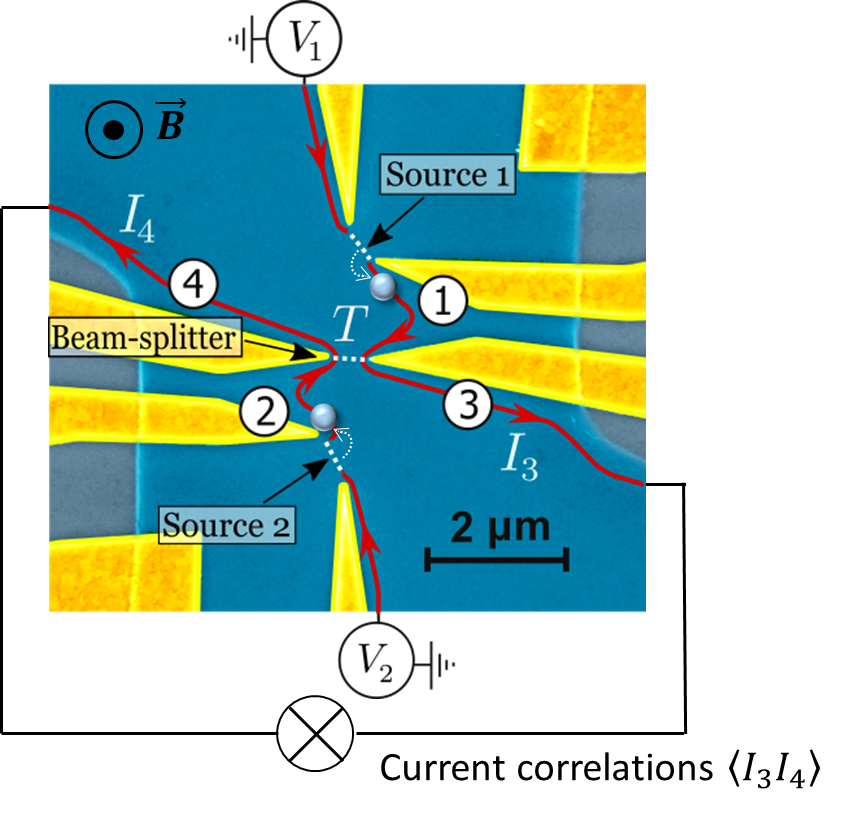
Fractional anyonic statistics in mesoscopic colliders.
Our team studies the fractional statistics of anyons through anyonic colliders. These colliders consists of two anyon beams generated at the input of a beam splitter. At the present we have focused our efforts toward abelian anyons for which the accumulated phase due to the exchange of two quasiparticles can take arbitrary values between 0 (bosonic case) and π (fermionic case). We use high-mobility GaAs/AlGaAs heterostructures under large magnetic fields to reach the fractional quantum Hall regime whose elementary excitations are anyons. Sending the anyonic excitations towar a beam splitter and by measuring the correlations between output electrical currents, we can observe the natural tendency of anyons to bunch at the output of the splitter. This gives us information about their fractional statistics
- Contact Gwendal Feve
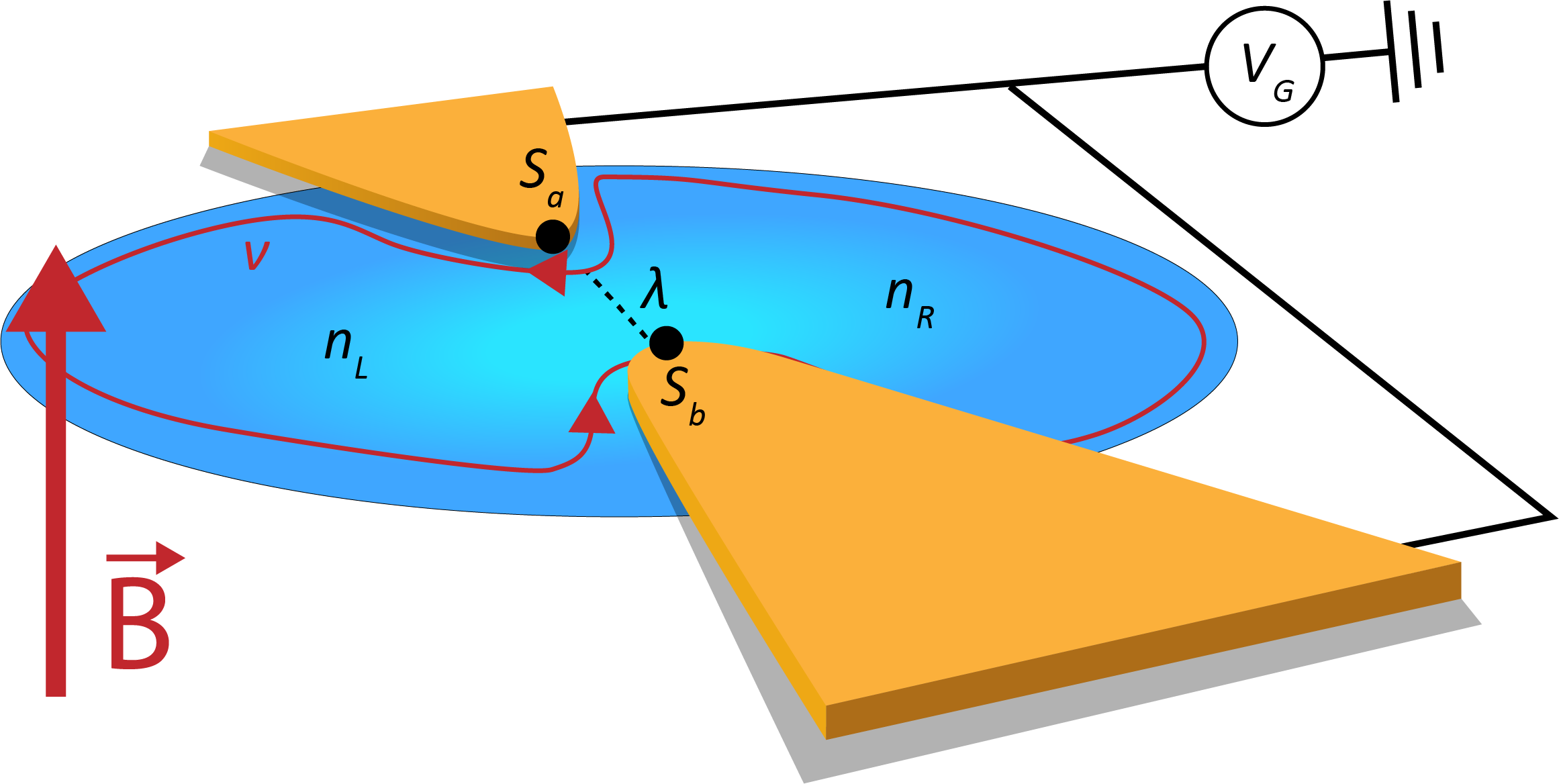
Resonators and radiofrequency interferometry in the quantum Hall effect.
Our team studies two-dimensional high-mobility electron gas (AsAlGa/AsGa) in order to realize magneto-plasmonic resonators in quantum Hall effect structures. The study of these resonators allow us to better understand the properties of the quantum Hall effect (integer and fractional) by studying the microwave absorption. One of the interests of this type of system is the possibility to build interferometers that could allow us to probe the statistical properties of fractional quasiparticles and, in particular, evidence their theorized non-abelian anyonic statistic.
- Contact Gerbold Menard
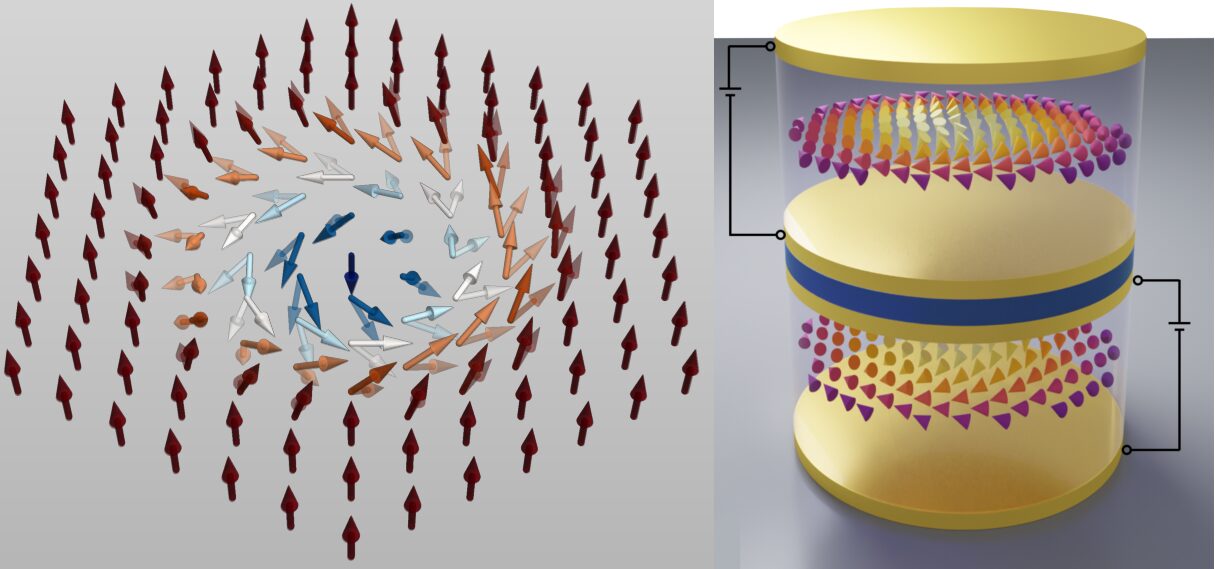
Quantum skyrmionics
Our team theoretically studies the quantum and nonequilibrium skyrmion dynamics with a focus on developing strategies for bringing a novel macroscopic qubit design based on magnetic skyrmions to fruition. In particular, we aim to understand the microscopic mechanisms that create noise, design schemes to control sources of decoherence built upon spectral engineering, study the coherent interaction of skyrmion qubits with other quantum modules, and achieve long-distance tunable qubit coupling.
- Contact Christina Psaroudaki

Probing exotic quantum Hall states using quantum heat transport
Under strong magnetic field and low temperature, electronic interactions in two-dimensional electron gas leads to strongly correlated, complex and exotic quantum Hall states. These states have been suggested as a basis for the implementation of new quantum circuits in order to perform topologically protected quantum calculations. While exciting, these states remain not fully understood as the quantum transport conventionnal experimental approach used to study them only provides limited information. In particular, electronic transport only probes the physics of edge mides that carry the current in the quantum Hall effect. These states propagate on the edges of the electron gas and do not explore the physics of the bulk of the sample. To obtain a better understanding of these exotic states as well as their origin, we propose a new approach, non-conventionnal based on heat transport that allows one to directly probe the heat-carrying neutral collective modes that characterize these interaction induced states.
- Contact François Parmentier
- The personal webpages of the team members can be found on the directory.
Hiring
- Contact Gwendal Feve , Gerbold Menard , François Parmentier ou Christina Psaroudaki for more information.
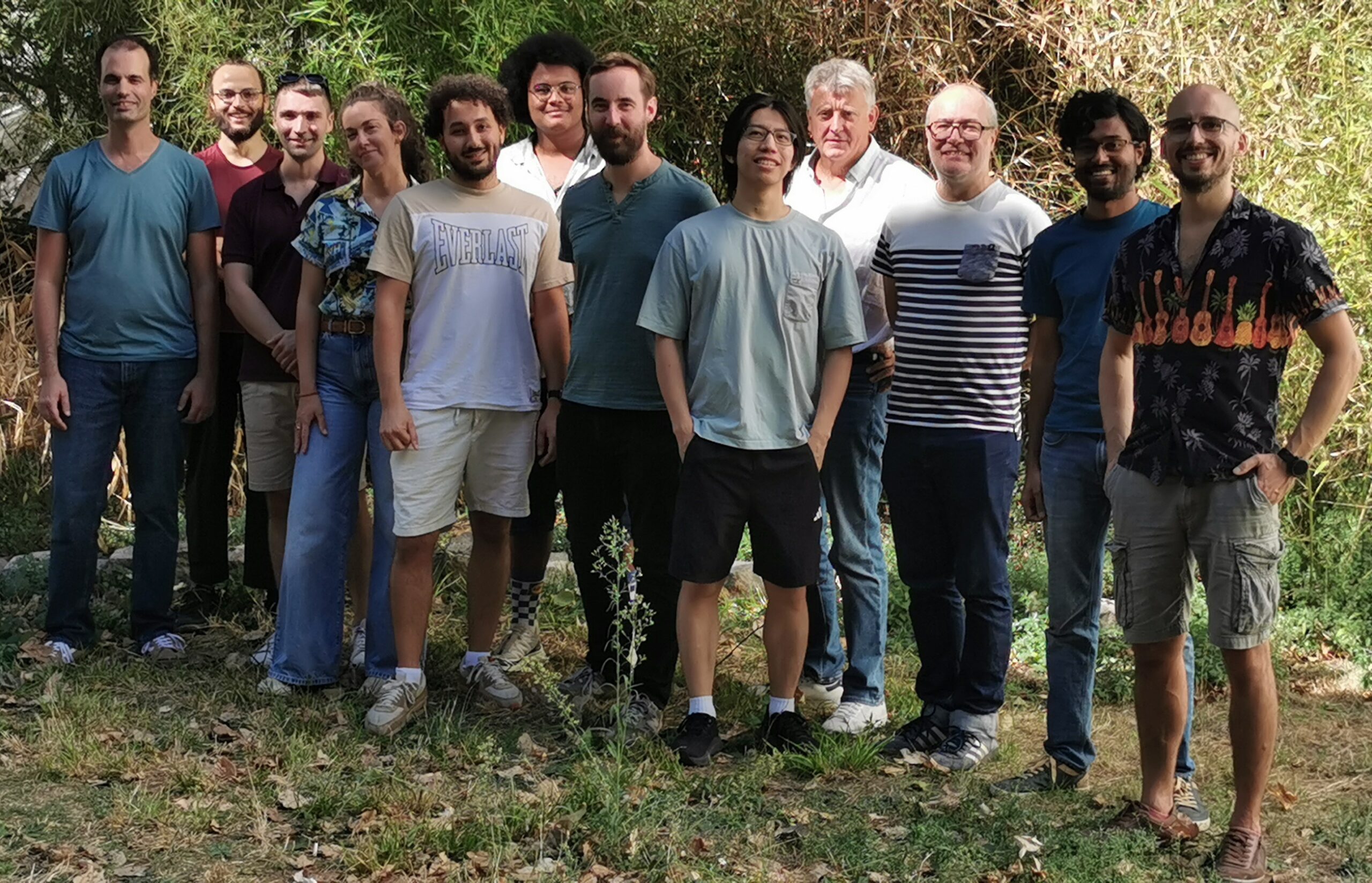
Team members
Team leader
Permanent staff

Emeritus
Post-doctoral fellows

PhD students


Alumni
Elric Frigerio, PhD student, defended in 2025.
Mélanie Ruelle, PhD student, defended in 2024, currently post-doctoral researcher at the university of Cologne.
Bernard Plaçais, CNRS senior research, founder and previous team leader, retired in 2023.
Aurélien Schmitt, PhD student, defended in 2023, currently research enginneer at LPENS clean room.
Alexandre Gourmelon, PhD student, defended in 2022.
Hugo Bartolomei, PhD student, defended in 2022.
Holger Graef, PhD student, defended in 2019.
Arthur Marguerite, PhD student, defended in 2017, currently CNRS researcher at ESPCI.
Manohar Kumar, post-doc, currently researcher at Aalto university, Finland.
Rémi Bisognin, PhD student.
David Mele, post-doc, currently assistance professor at JUNA (Lille).
Quentin Wilmart, PhD Student, defended in 2015, currently researcher at CEA-LETTI (Grenoble).
Vincent Freulon, PhD student, defended in 2014, currently teaching at the Louis-le-Grand highschool (Paris).
Erwann Bocquillon, PhD student, defended in 2012, then CNRS researcher in the team (2016-2021), currently professor at Kölm university, Germany. François Parmentier, PhD student, defended in 2010, currently CNRS researcher at CEA Saclay.