










The behavior of electrons on a lattice subjected to a strong magnetic field has long been a mystery in condensed matter physics. This led to the discovery of the Hofstadter butterfly, one of the most famous examples of fractality in physics. The Hofstadter butterfly is known to result in a robust quantization of electrical conductance, linked to the presence of topological states called Chern insulators. The Mesoscopic Physics team has shown for the first time that the Hofstadter butterfly also gives rise to a quantized thermal flow. To do so, the team performed thermal transport measurements in graphene aligned with hexagonal boron nitride, forming a moiré pattern that acts as an electronic lattice. The team observed that in all Chern insulators of the Hofstadter butterfly, including the most exotic ones where electronic interactions play a major role, the electrical and thermal conductances are uniquely determined by a single number, called a topological invariant, or Chern number. This experiment, conducted in collaboration with researchers from SPEC (CEA Saclay), C2N (Palaiseau), and NIMS in Japan, highlights the importance of topology in condensed matter physics, which universally determines the properties of a given system, regardless of its microscopic details.
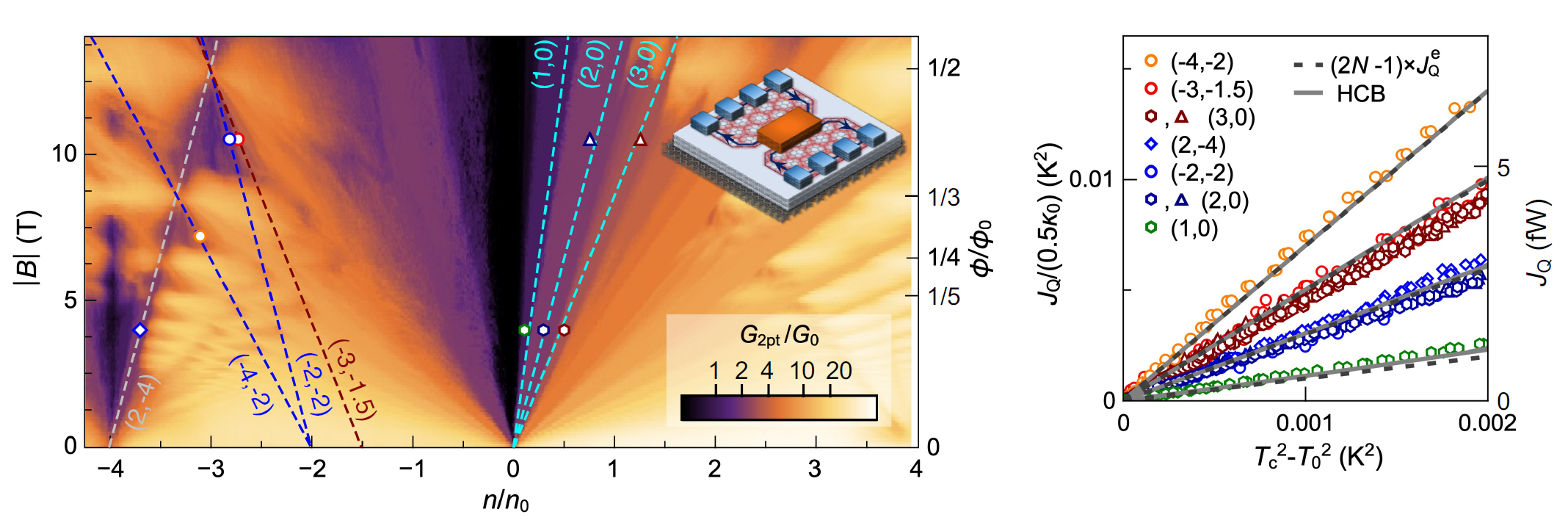
Left: electrical conductance of the device versus density and magnetic field. Dashed lines indicate the quantized topological insulator states probed in the experiment, labelled by the solutions (t,s) of the Diophantine equation. Right: heat flow versus squared temperature, for all states shown on the left panel. Dashed lines: quantized heat flow prediction with N channels per edge. Full lines: heat flow prediction including strong interaction effects.