










In quantum circuits, information is fragile, easily slipping away through unwanted interactions with the environment. One way to protect it is by carefully shaping how a system loses energy, an approach known as dissipation engineering. Previously, the Quantic team demonstrated this concept in a superconducting resonator by making it lose photons in pairs. As a result, the system autonomously stabilizes in a so-called Schrödinger cat qubit. Cat qubits are intrinsically protected against one type of quantum error, known as bit flips, but remain vulnerable to the other type, called phase flips.
In this work, we take a step further by showing that a high-impedance resonator can be engineered to lose photons in quartets. This capability provides the key ingredient needed to stabilize four-component cat qubits, an enhanced form of standard cat qubits that can correct both bit flips and phase flips. Although full stabilization has not yet been achieved, these results mark important progress toward hardware-efficient quantum error correction.
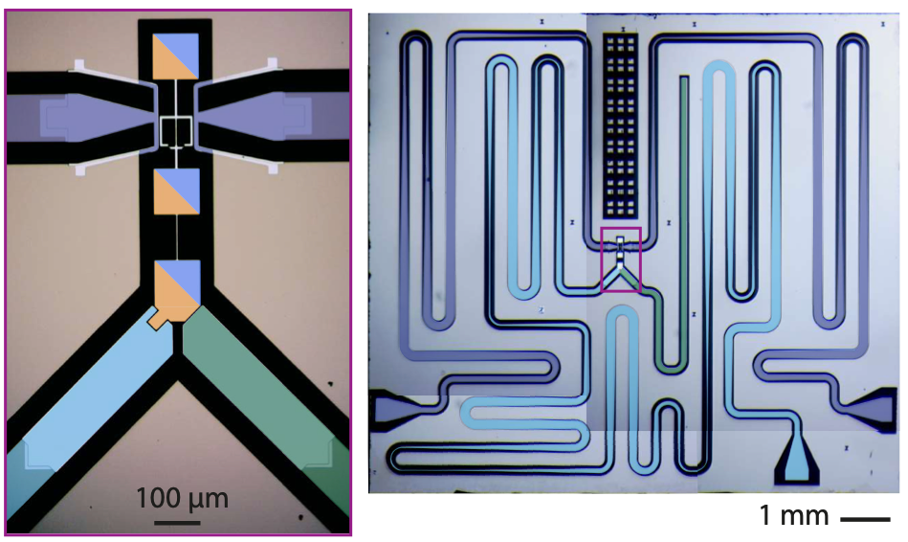
False-color microscope images of our circuit. The blue and purple meandered structures are 1D-microwave photonic crystals that allow us to control the circuit while protecting it against single-photon loss.